


Medicaid and the Children’s Health Insurance Program (CHIP)1 provide free or low-cost health coverage to some low-income people, families and children, pregnant women, the elderly, and people with disabilities. Medicaid and CHIP can play a role in improving health care access and health outcomes for individuals with sickle cell disease. More than half of the people nationwide affected by SCD are enrolled in Medicaid or CHIP. A social worker at your SCD clinic can help connect you with these resources. For more information on Medicaid and SCD, click here.2
To apply for health coverage, visit HealthCare.gov and search based on the state where you live.
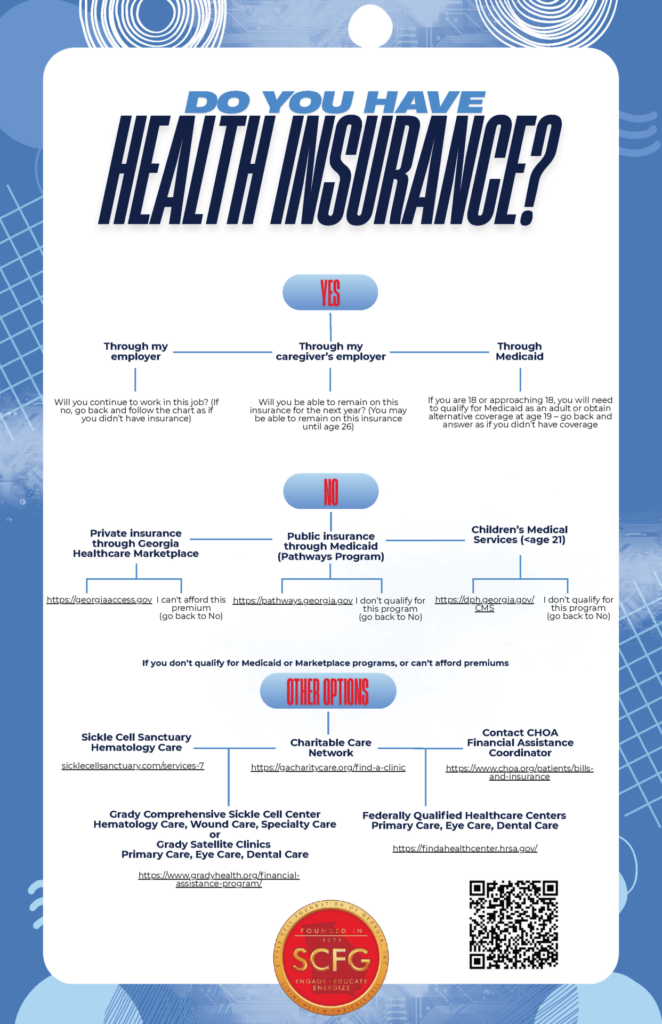
Questions about your insurance coverage? Walk through this interactive tool created by the Sickle Cell Foundation of Georgia or take a look at the flowchart below!
Patients and families should watch for the following conditions that need an urgent medical evaluation:
• Fever of 101° F or higher
• Chest pain
• Shortness of breath
• Increasing tiredness
• Abdominal swelling
• Unusual headache
• Any sudden weakness or loss of feeling
• Pain that will not go away with home treatment
• Priapism (painful erection that will not go down)
• Sudden vision change
Medicaid and the Children’s Health Insurance Program (CHIP)1 provide free or low-cost health coverage to some low-income people, families and children, pregnant women, the elderly, and people with disabilities. Medicaid and CHIP can play a role in improving health care access and health outcomes for individuals with sickle cell disease. More than half of the people nationwide affected by SCD are enrolled in Medicaid or CHIP. A social worker at your SCD clinic can help connect you with these resources. For more information on Medicaid and SCD, click here.2
To apply for health coverage, visit HealthCare.gov and search based on the state where you live.
Questions about your insurance coverage? Walk through this interactive tool created by the Sickle Cell Foundation of Georgia or take a look at the flowchart below!
Patients and families should watch for the following conditions that need an urgent medical evaluation:
• Fever of 101° F or higher
• Chest pain
• Shortness of breath
• Increasing tiredness
• Abdominal swelling
• Unusual headache
• Any sudden weakness or loss of feeling
• Pain that will not go away with home treatment
• Priapism (painful erection that will not go down)
• Sudden vision change
Medicaid and the Children’s Health Insurance Program (CHIP)1 provide free or low-cost health coverage to some low-income people, families and children, pregnant women, the elderly, and people with disabilities. Medicaid and CHIP can play a role in improving health care access and health outcomes for individuals with sickle cell disease. More than half of the people nationwide affected by SCD are enrolled in Medicaid or CHIP. A social worker at your SCD clinic can help connect you with these resources. For more information on Medicaid and SCD, click here.2
To apply for health coverage, visit HealthCare.gov and search based on the state where you live.
Questions about your insurance coverage? Walk through this interactive tool created by the Sickle Cell Foundation of Georgia or take a look at the flowchart below!
Patients and families should watch for the following conditions that need an urgent medical evaluation:
• Fever of 101° F or higher
• Chest pain
• Shortness of breath
• Increasing tiredness
• Abdominal swelling
• Unusual headache
• Any sudden weakness or loss of feeling
• Pain that will not go away with home treatment
• Priapism (painful erection that will not go down)
• Sudden vision change