


Sickle Cell Articles in Black Magazines
Ebony and Jet have highlighted news stories that are marketed specifically towards African-Americans since 1945 and 1951 respectively. Because sickle cell trait and disease affects many African-Americans, it has been covered in several articles in both Ebony and Jet magazines. According to the National Institute of Health, about 1 in 13 African-American babies are born with sickle cell trait and about 1 in 365 black children are born with sickle cell disease. In this section, we have summarized a few articles from a myriad of magazine articles from over several decades that discuss sickle cell. These articles raise sickle cell awareness, highlight individual actors and organizations that have made a difference, share information, personal stories, and more.
Early History of Sickle Cell Disease

To the left is an image of Africanus Horton, also known as James Beale. He was born in 1835 in Gloucester Village, Sierra Leone, to parents of Igbo descent. The British chose Dr. Horton to be trained as the army medical officer for their post in West Africa. He began his training at the University […]
Documents Relating to Dr. Francis-McBarnette

Dr. Francis-Mcbarnette, an American pediatrician, was a pioneer in treating children with sickle cell anemia.
Uncertain Suffering (2009)
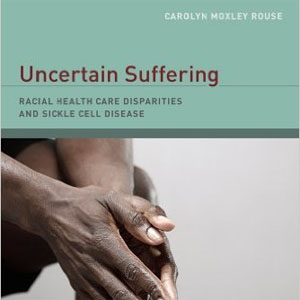
In a wide ranging analysis that moves from individual patient cases to the compassionate yet distanced professionalism of health care specialists to the level of national policy, Carolyn Moxley Rouse uncovers the cultural assumptions that shape the quality and delivery of care for sickle cell patients. She reveals a clinical world fraught with uncertainties over how to treat black patients given resource limitations and ambivalence. Learn more and buy the book on Amazon.
Managing Sickle Cell Disease: In Low-Income Families (2003)

Shirley A. Hill examines how low-income African American mothers with children suffering from this hereditary, incurable, and chronically painful disease, react to the diagnosis and manage their family’s health care. Learn more and purchase the book on Amazon.
Backdoor to Eugenics (2003)

Considered a classic in the field, Troy Duster’s Backdoor to Eugenics was a groundbreaking book that grappled with the social and political implications of the new genetic technologies. Completely updated and revised, this work will be welcomed back into print as we struggle to understand the pros and cons of prenatal detection of birth defects; gene therapies; growth hormones; and substitute genetic answers to problems linked with such groups as Jews, Scandanavians, Native American, Arabs and African Americans. Duster’s book has never been more timely. Learn more and purchase the book on Amazon.
People’s Science: Bodies and Rights on the Stem Cell Frontier (2013)
People’s Science uncovers the tension between scientific innovation and social equality, taking the reader inside California’s 2004 stem cell initiative, the first of many state referenda on scientific research, to consider the lives it has affected.
Photos from It’s in the Blood! A Documentary History of Linus Pauling, Hemoglobin, and Sickle Cell Anemia
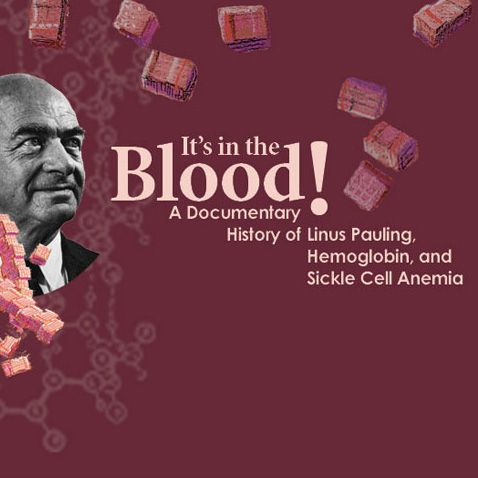
These images were pulled from the It’s in the Blood! A Documentary History of Linus Pauling, Hemoglobin, and Sickle Cell Anemia which was originally put together by the Special Collections & Archives Research Center at Oregon State University. The documentary provides a closer look at Pauling’s work in blood biochemistry and molecular disease primarily through narratives, timelines, media, and primary documents. Click on the image to left to view some of the pictures from the collection.
Sickle Cell Disease – A Lethal Advantage: Video Series from the Open University

The History of the Sickle-Shaped Cell – Sickle Cell Disease: A Lethal Advantage (1/5) This is the first part of a video series from Open University. This video tracks the history of sickle cell beginning with the very first diagnosis. Sickle Cell and the Gene – Sickle Cell Disease: A Lethal Advantage (2/5) The second part […]
Photograph of Dr. Clarice D. Reid

This is a photograph of Dr. Clarice D. Reid who was the pediatrician who led the National Sickle Cell Disease Program at the U.S. National Heart, Lung, and Blood Institute with the National Institute of Health.
U.S. Postage Stamp (2004)
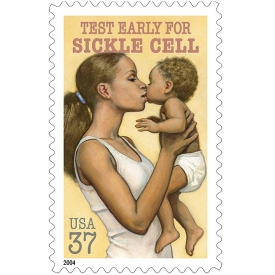
In 2004, the U.S. Postal Service created this stamp as part of a program to raise public awareness on sickle cell disease.
Photograph of Dr. Marilyn Gaston

This is a photo of Dr. Marilyn Gaston who is internationally recognized for her work on sickle cell and helping children manage the illness.
Richard Severo, New York Times Article Series on Genetic Screening & Sickle Cell Disease (1981-1982)

AIR ACADEMY TO DROP ITS BAN ON APPLICANTS WITH SICKLE CELL GENE: February 4, 1981 This New York Times article is the first of a series to cover the removal of a ban that excluded Air Force Academy applicants with a single gene for sickle cell anemia. DUPOINT DEFENDS GENETIC SCREENING: OCTOBER 18, 1981 […]
Forward to Living in the Genetic Age: New Issues, New Challenges (2009)
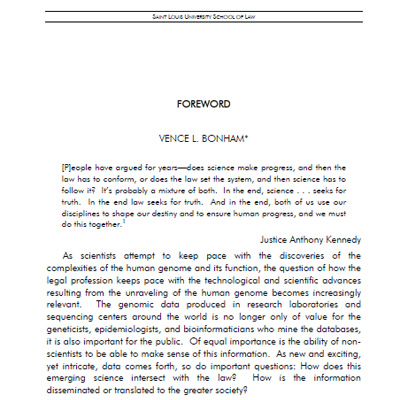
By Vence L. Bonham
Saint Louis University Journal of Health Law & Policy, Volume 3, Issue 1, 2009
Sickle Cell Anemia: A Report of Eight Cases, One With Necropsy (1934)
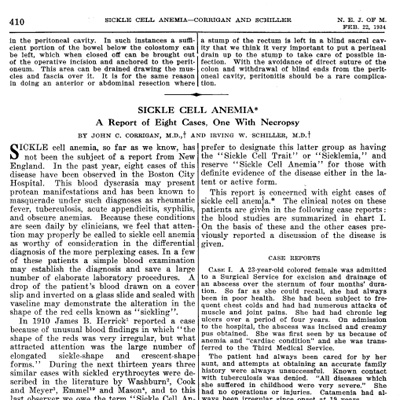
By John C. Corrigan, M.D., and Irving W. Schiller, M.D.
New England Journal of Medicine, Volume 210, Number 8, pages 410-417
Sickle-Cell Disease (1997)
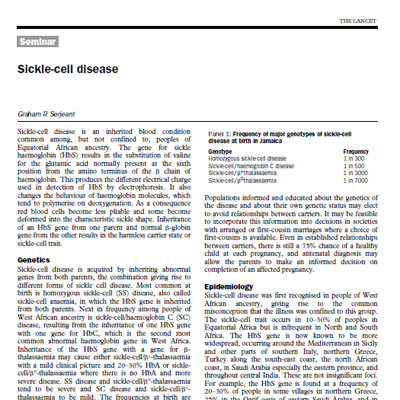
By Graham R. Serjeant
Lancet, Volume 350, pages 725-730
The Inheritance of Sickle Cell Anemia (1949)
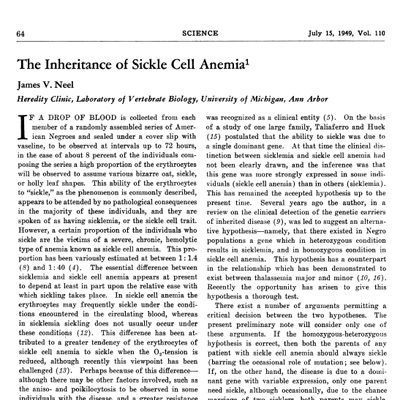
By James V. Neel
Science, Volume 110, pages 64-66
A Century of Progress: Milestones in Sickle Cell Disease Research and Care

Download a PDF timeline from the National Heart Lung and Blood Institute on the history of advancements in sickle cell disease treatment and research.
History of the Research Effort and Historical References
A summary of progress at the Georgia Comprehensive Sickle Cell Center at Grady Health System, Atlanta, Georgia, along with a list of references.
Peculiar elongated and sickle-shaped red blood corpuscles in a case of severe anemia (1910, 2001)
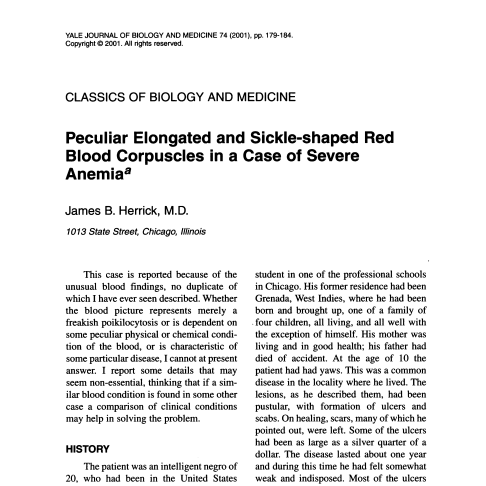
Download a PDF of the original paper.
Sickle Cell Anemia, A Molecular Disease (1949)
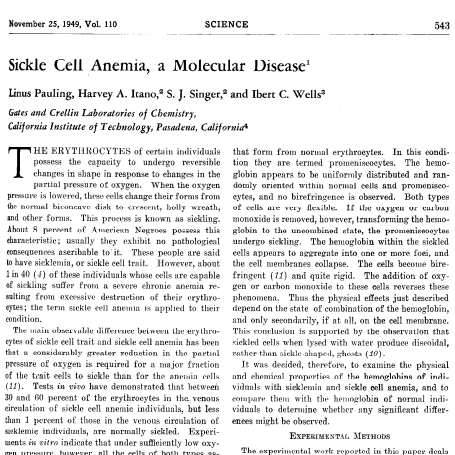
Download a PDF of the original paper.
National Sickle Cell Anemia Control Act (1972)
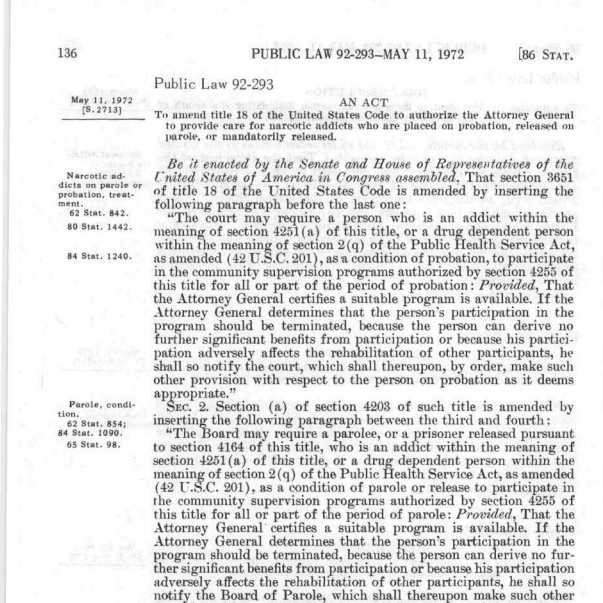
Download a PDF of the document.
Body & Soul: The Black Panther Party and the Fight against Medical Discrimination (2013)

Author: Alondra Nelson
Alondra Nelson deftly recovers an indispensable but lesser-known aspect of the organization’s broader struggle for social justice: health care.
The Social Life of DNA (2016)
Authors: Alondra Nelson
In The Social Life of DNA, Nelson explains how cutting-edge DNA-based techniques are being used in myriad ways, including grappling with the unfinished business of slavery: to foster reconciliation, to establish ties with African ancestral homelands, to rethink and sometimes alter citizenship, and to make legal claims for slavery reparations specifically based on ancestry.
Genetics and Global Public Health: Sickle Cell and Thalassaemia (2012)
Authors: Simon M. Dyson & Karl Atkin
Genetics and Global Public Health presents a new concluding chapter which highlights the critical nature of social science research for sickle cell and thalassaemia communities, providing key insights into the social contexts of human behaviour and analysing how societal arrangements could change to assist people living with either condition.
In the Blood: Sickle Cell Anemia and the Politics of Race (1998)
Author: Melbourne Tapper
In the Blood argues that ever since the discovery in 1910 and subsequent scientific analysis of the disease, sickle cell anemia has been manipulated to serve social ends-as a tool for securing white identity and a way to establish a hierarchy based on European heritage.
The Enculturated Gene: Sickle Cell Health Politics and Biological Difference in West Africa (2011)
Author: Duana Wiley
The Enculturated Gene reveals how the notion of an advantageous form of sickle cell in this part of West Africa has defined – and obscured – the nature of this illness in Senegal today.
The Troubled Dream of Genetic Medicine (2008)
Authors: Keith Wailco & Stephen Pemberton
In this captivating account, historians Keith Wailoo and Stephen Pemberton reveal how Tay-Sachs, cystic fibrosis, and sickle cell disease―fraught with ethnic and racial meanings for many Americans―became objects of biological fascination and crucibles of social debate.
Dying in a City of Blues: Sickle Cell Anemia and the Politics of Race and Health (2001)
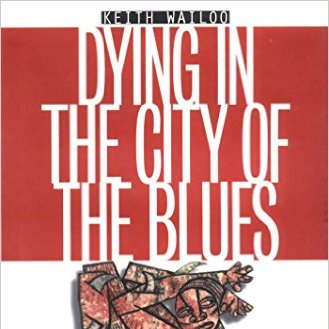
Author: Keith Wailoo
This groundbreaking book chronicles the history of sickle cell anemia in the United States, tracing its transformation from an “invisible” malady to a powerful, yet contested, cultural symbol of African American pain and suffering.